I. Topics
poetic or
a) Renaissance
Sleep.
Night.
stars.
The 'can sleep. "
nocturnal birds, the eagle.
The "dumb fish."
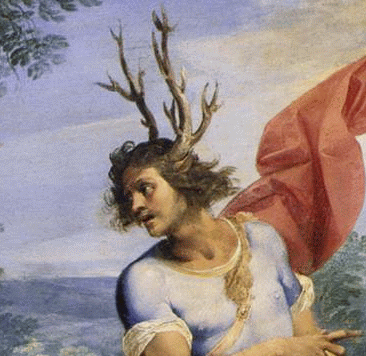
Wild animals: deer (Actaeon) and the lion, the skilled hunter.
The thief and the lover as characters of the night.
The sun, "fiery planet."
The "poor little boat" and Sirte.
flowers, the lily and the rose, the teaching of the rose, the makeup on women.
The "blue gold" of the sky.
Silence: Hippocrates. -30 →
b) Mythological
The Triple Goddess: the Moon.
Nictimene, the owl.
Minerva Tree, olive.
Three Theban maidens, daughters of MINI.
Ascalaphus, owls and "minister of Pluto."
Alcione.
Actaeon the stag.
The bird of Jupiter: eagle.
Morpheus, god of dreams, son of Night and Sleep.
The Forge of Vulcan: the stomach.
Olympians.
Jupiter Thunderer, holder of the beam.
Alcides or Hercules, owner of the club.
Apollo, the sun.
Apollo, god of medicine.
Icarus.
Thetis, mother of the waters and algae.
Arethusa: the sources.
Pluto.
Champs Elysees.
Ceres.
Proserpina.
Venus, "Cipria Goddess."
Atlante and Alcides, prototypes superhuman strength.
Phaeton.
Venus, morning star.
Aurora, wife of Tithonus.
Fame (in conjunction with Phaethon).
c) Religious
The Tower of Babel (Genesis X, 4-9).
the statue Nebuchadnezzar dreamed (Daniel, II, 31-33).
The "mighty angel coming down out of heaven" ("Apocalypse? Plancarte Méndez See note to vv. 680 et seq.).
God the Creator, "Eternal Author."
d) Historical and legendary
The Lighthouse of Alexandria.
The Pyramids of Egypt.
The Ptolemies.
Homer, Achilles and Odysseus.
Galen doctors. -31 →
II.
scientific topics or
a) Physio-psychological
Intuitive knowledge: Plato. Knowledge
discursive ten categories: Aristotle.
inner senses: estimate, imagination, memory, fantasy.
The four humors: blood, phlegm, anger, melancholy.
The three powers of the soul: intellect, memory, will.
heart.
arteries.
The lung. The wet
radical.
stomach.
The brain.
b)
Astrology Astrological natural
: astronomy.
judicial astrology: astrology.
Ptolemaic universe, the sphere, celestial bodies.
c) physical and natural history
The four elements: earth, water, air, fire.
minerals.
vegetables.
animals.
Man.
The five senses.
The Magic Lantern.
glare of the eyes.
d) Legal Office
reign.
legal language applied to "theft of innate heat" and the distribution of sunlight.
Tips to follow to public errors, such as the Phaeton.
e)
music "Guidelines to the cerulean sky flat" (v. 949).


0 comments:
Post a Comment