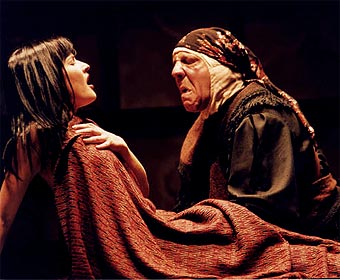
The work devoted to Fernando de Rojas with his contemporaries and to posterity was La Celestina tragicomedy considered one of the masterpieces of English literature and universal.
is a transitional work between the Middle Ages and the Renaissance, written during the reign of Ferdinand and Isabella, whose first known edition dates from 1499. Constitutes a basis on which cemented the birth of the modern novel and drama.
A hotly debated question is which part of La Celestina, exactly, wrote Rojas.
Today, everyone agrees on who is the author of Acts II through XVI of Comedy original, and few dissenting voices can doubt his paternity in relation additional acts, the interpolations and the last "arguments."
But the question of who is the author of Act I is still standing. The general trend has been to believe the words of Rojas, who claimed to have found the act, in the interpolations of Tragicomedy suggests it could be Rodrigo de Cota and Juan de Mena. Both functions have been discussed and the possibility that Cota is the author seems to be the most consistent of the two. It must be said that Menendez Pelayo argued with conviction that the act I was also written by Rojas.
La Celestina is a tragicomedy set in dialogue organized in twenty acts modeled after the Italian humanistic comedy.
The main stylistic weapons Rojas used to communicate its complex message are the comedy and comedy drama, linked by means of the irony. Rojas explores mainly helping the human condition both its sense of humor and its sense of tragedy.
theater was considered to be read, not to be represented, which abounds sentimental and psychological analysis, aspects that resemble the novel. As humanistic comedy combines features of the theater (the form of a dialogue) and novel (the emotional and psychological tone and frequent changes scenario).
The plot summary tells the story of Calisto, a young noble, handsome and illustrious genius, who is deeply in love with Melibea. To overcome the obstacles that prevent it from reaching his beloved, and Sempronio advised by his servant, decides to go to a old bawd, Celestina, who achieved, through trickery, love of the young, taking advantage of the situation for personal gain . Its enormous greed eventually causing their death, the successor of the servants of Calisto, Celestina also join the business built around the pair of lovers who are caught and executed.
Upon hearing the news, Elicia and Areusa, lovers of the servants, decide to avenge their deaths by going for it to Centurio, ruffian who organizes a gang to give a jolt to the lovers who had made a date night. Calisto, who was sleeping in the arms of Melibea, was uneasy and was launched in the dark to find the source of the noise, stumbling in their path and finely dying without confession. The play ends with the suicide of Melibea, after lamenting the ephemeral and fleeting of his love, and crying Pleberio, father of the girl, who stars in moral reflections end the tragicomedy.
The work contains a strong critical load, in which the author paints a bitter portrait of a society that calls itself Christian but moves by selfishness, self-interest. Topics such as greed, envy, hatred or revenge run along the pages of this book that portrays a society in crisis, a society whose values \u200b\u200bare centered on individualism and reflects a world suffering from a crisis both moral and social order.
Love is the defining issue, the focus of the work, which dictates that raises the behavior of all the characters (The only two characters who are victims of love are Pleberio and Alisa, parents Melibea, but its role in the work more symbolic, as bearers of institutional values \u200b\u200b(parenting, moral) than real).
characters flaunt their greed, taking advantage of a feeling so pure and sincere as the love to get a personal interest, disguising their actions, which actually contain the purest selfishness.
Fernando de Rojas is a humanistic comedy incomplete, with a courtly lover who has great comic potential and parody, Callisto, and decides not as complete as comedy but as a sentimental novel parody and dialogue that is both tragic and comical.
The author puts draw special attention to the mood of the work and to warn the reader not to be distracted by it completely encloses the serious intentions. Rojas is the tragicomedy more specifically as a negative example, moralistic and didactic of the disasters that they face those who succumb to the desire.
The style appears throughout the book is a perfect synthesis of a cultured and scholarly language with a language as vivid as vulgar. Thus presents a double dimension, which corresponds, in general terms, with two groups of characters in the play: a language worship, high and very elaborate, own social class of lords and popular language typical of the lower classes, characterized by speed, spontaneity and liveliness of the dialogue and the use of proverbs, popular sayings and insults. Thus, the two streams converge, classical and popular, given in English literature in the late fifteenth century.
The work fits within a few modules thought responding faithfully to the horizon of the fifteenth century. All topics of medieval secular literature can be found in one form or another in the work. So Fernando de Rojas tried to capture in the work the vision he had of the society of his time and circumstances in which he played living in Spain in the XV and XVI. A society in which prevailing interest money and the pursuit of pleasure, selfishness, and the confrontation between social groups. A vision undoubtedly pessimistic world, which may have as much to convert the status of the author, as the crisis of a world that collapses, the medieval, and another who is about to emerge, the Renaissance.
From my point of view, it is astonishing modernity showing this work, the richness of his characters, the realism of language and environmental situations, the ease and naturalness of the dialogue. It is amazing how the author uses two main weapons, comedy and tragedy, seemingly opposite, but manages to combine perfectly, giving humorous touches to a love story with a bitter denouement.
Elena Rivera Liarte
4 º DENTAL
San Pablo CEU University


0 comments:
Post a Comment